
Waste sorting
Behind the student dormitory building you will find four separate waste containers: packaging, paper and cardboard, bio-waste, and mixed household waste.
Please make sure to place your waste in the correct container to ensure that as much material as possible can be recycled.
Even one carelessly placed trash bag can contaminate an entire container and make proper sorting impossible. In such a case, the whole container must be treated as mixed waste, and all previous sorting efforts are lost. Every correctly sorted bag helps protect the environment, reduce waste–related costs, and support a functioning circular economy.
What to keep in mind?
1. In Estonia, it is mandatory to collect bio-waste separately from all other waste types. This is required for several reasons:
- Bio-waste cannot be separated from mixed waste afterwards.
- When mixed with other waste, bio-waste contaminates recyclable materials, making their recycling impossible and increasing the amount of waste that must be burned or landfilled.
- When landfilled, bio-waste produces landfill gas, a potent greenhouse gas that contributes significantly to climate change.
- Bio-waste is a valuable resource. In Estonia it is mainly used to produce compost, returning nutrients to the soil. In the coming years, biogas production is also expected to grow — biogas can be used as vehicle fuel, for heating buildings, and for generating electricity.
2. If you are not sure where an item belongs, you can use the RecycleMore app and its waste scanner to check. The app identifies items based on a photo and tells you exactly which bin to use.
3. If you do not wish to sort all waste fractions separately, then you must still place all bio-waste in the bio-waste container, as mixing it with other waste is prohibited and causes significant environmental harm.
Other waste types may be placed in the mixed household waste container if necessary, but we encourage you to sort packaging and paper/cardboard whenever possible to support recycling.
Below you can find detailed information about each waste category — what belongs where and how to sort it properly.
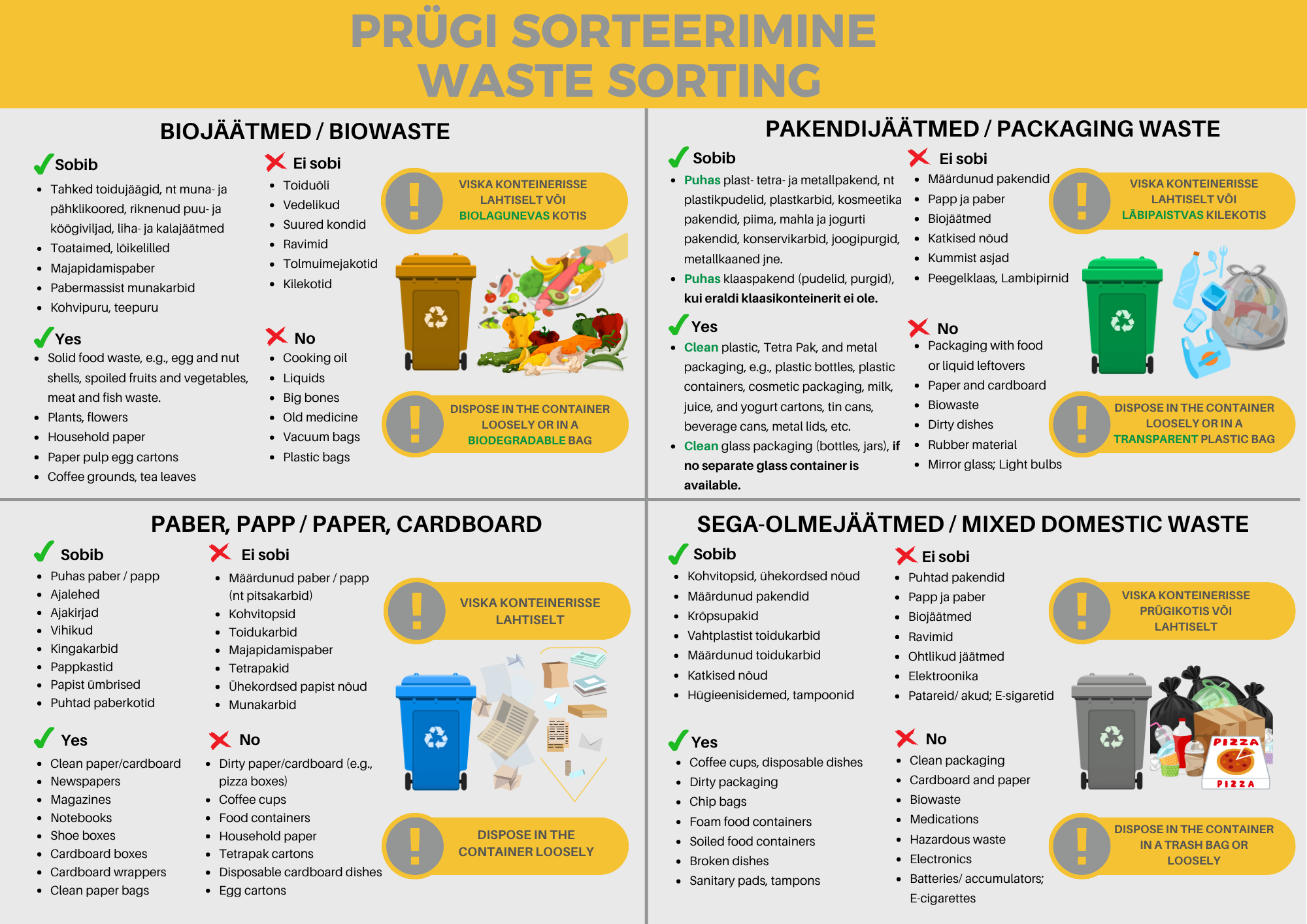
Suitable for: drink cartons, metal packaging, glass packaging and plastic packaging.
Packaging must be empty, clean, and dry, and it should not contaminate other waste.
Please place packaging in the container either loose or in a transparent plastic bag.
This container is for clean paper and cardboard, such as newspapers, magazines, notebook pages, cardboard boxes, and paper bags.
Important:
- Paper and cardboard must be completely clean — do not place dirty or greasy items, such as used pizza boxes, inside.
- Flatten or break down large cardboard boxes before placing them in the container to save space.
Why sort paper and cardboard separately?
Paper and cardboard are easy to recycle when they are clean and dry. By sorting them separately, you help save natural resources, reduce waste going to landfills, and make it possible to produce new paper and packaging materials from recycled fibers.
Biowaste consists of decomposable and compostable food and kitchen waste.
Biowaste must be collected separately from other waste!
This is important because biodegradable waste can be reused – for example, to produce compost or biogas.
Items suitable for the biowaste container include:
- Food waste such as meat and fish scraps, fruit and vegetables (including peels), bread, pastries, semi-prepared foods, baked goods, cheese, butter, margarine, and other solid food residues.
- Household paper, paper napkins, coffee grounds, and paper filters.
- Houseplants and cut flowers.
- Teabags, only if they are made of 100% biodegradable material.
Please note:
- Ordinary plastic bags are not suitable for biowaste — they belong in plastic packaging recycling.
- Empty food packages should go into metal, plastic, cardboard, or glass packaging recycling, depending on the material.
In the Student Hostel, each apartment has a green biowaste collection bin.
You can collect biowaste in a biodegradable bag or paper bag — in this case, you can throw the entire bag into the outdoor biowaste container.
If you use a plastic bag, you must empty the biowaste loosely into the outdoor container and then dispose of the plastic bag separately in the packaging recycling bin.
Mixed waste includes all other waste that cannot be sorted separately. All remaining rubbish that is left after sorting recyclables can be disposed of in the mixed waste container.
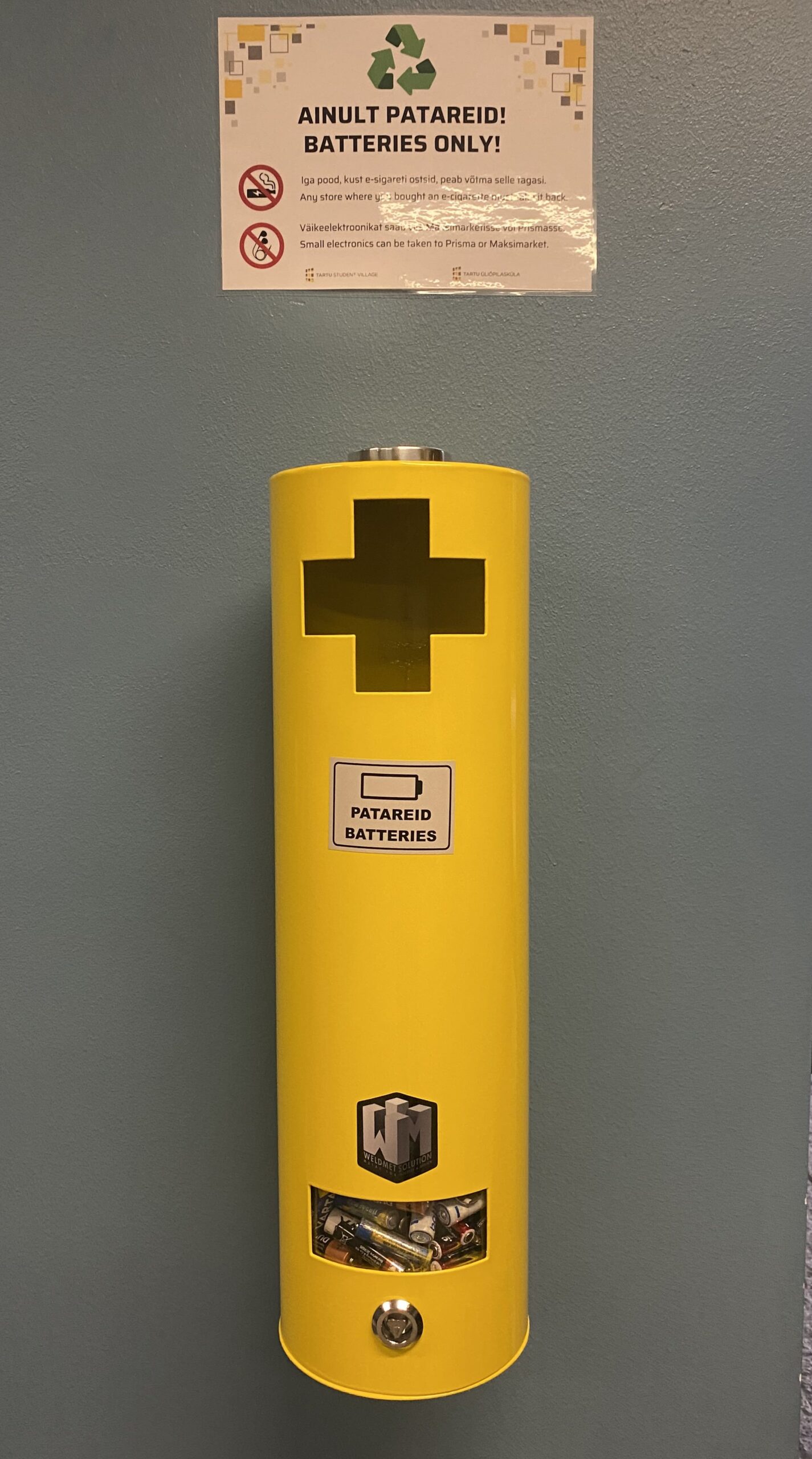
Many components of old batteries are toxic and pose a hazard to our natural environment and our health. You can take your old batteries to the designated box at your residence hall lobby.
Estonia has a refundable beverage packaging deposit system. Plastic, glass, and metal containers for drinks – such as water, soft drinks, beer, cider, and alcoholic beverages – can be returned to a reverse vending machine to get back the deposit you paid.
The nearest reverse vending machines to the Raatuse 22 Student Hostel are located in the Raatuse Business Center Selver and in the Kivi Coop grocery store. When you return your beverage containers, you’ll receive a receipt that you can either exchange for cash in the same store or use as a means of payment – the amount shown on the receipt will be deducted from the total of your shopping.
Saving energy
Each of us has the power to make a difference. Even one small and conscious action can help save energy, protect the environment and reduce costs for everyone. When we act all together our combined impact becomes significant.
Energy is a valuable resource that affects not only our daily comfort but also the future of our planet. By using electricity, water, and heating more wisely, we can reduce unnecessary consumption, lower our carbon footprint and support a more sustainable lifestyle.
You don’t need to make big sacrifices — just small, mindful choices in your everyday habits. See below for simple ways to save energy and make your living environment greener, more efficient and more responsible.
Turn off the light when leaving the room. Do this also when using the common rooms of the student residence.
- Turn off and unplug devices that are not in use. Don’t just leave your phone or laptop charger plugged in.
- Avoid operating devices in standby mode. The main devices that consume energy in standby mode are computers, television sets, coffee machines, audio equipment, and ovens with a digital clock. When the computer is not in use, it is wise to turn it off completely instead of putting it to sleep mode.
- Avoid charging smart devices overnight. Smartphones and tablets fill up in just a few hours. A fully charged smart device on the charger both consumes energy and shortens battery life.
- Avoid putting warm food in the refrigerator and adjust the refrigerator to the optimal temperature (recommended cool space temperature 4-5 °C and freezer temperature -18 °C). It is also important to defrost the refrigerator regularly to prevent the accumulation of excess ice and thereby reduce the efficiency of the refrigerator.
- Boil the water with an electric kettle according to the required amount.
Optimize the use of electric floor heating in the bathroom. In the case of electric floor heating in the bathroom, the temperature can be adjusted lower and it can be turned off when the bathroom is not used for a longer period of time (for example, when leaving the student residence for a vacation).
- Turn off the water if you are not using it at the moment – both when showering and brushing your teeth, as well as when washing dishes. When washing the dishes, do not let the water run continuously.
- If we were to shorten the time of showering by one minute and everyone in Estonia would do it, we would save up to 8 gigawatt-hours (GWh) of energy in one month –this is equivalent to the annual heating needed for more than 500 private houses.
- Wash the laundry in a full washing machine and prefer a lower washing temperature for not excessively dirty laundry. In many cases, a washing program with 30-degree water is sufficient for washing clothes.
- Report a dripping faucet or a broken toilet flush tank immediately so that the maintenance team can fix the problem as soon as possible.
- Adjust the temperature lower if possible. In a living room where a person stays for a long time, the temperature should not be lower than 18 degrees. Most people prefer a temperature of 21 degrees.
- Adjust the temperature as needed – there is no need to over-adjust the radiator, as in this case the room will not warm up faster. It is reasonable to adjust the thermostat reading according to the temperature or between 2 and 3.
- In winter, leave a free space in front of the radiators so to spread the heat into the room. Do not cover the radiator or the thermostat with a curtain.
- To ventilate the room, open all windows for a short time. Opening all the windows for a short period of time will air out the home faster, and will not allow the temperature of the walls and furniture in the room to drop.
Food sharing and second-hand corner
In the lobby of the Raatuse 22 student residence, there is a Foodsharing Tartu fridge, where volunteers bring rescued food.
Foodsharing helps save and share edible surplus food, reducing food waste and supporting a more sustainable lifestyle.
In addition, there is a Second-hand Corner in the Raatuse 22 lobby, where residents can leave or take clean and usable clothes and other items. It’s a great way to give things a second life and help others at the same time.